

Low Back Pain? It’s Not Always a “Weak Core”
If you’ve experienced low back pain, you may have been told, “You just need to strengthen your core.” While strengthening the trunk can absolutely be part of a successful rehabilitation program, the idea that low back pain is simply caused by a weak core is an oversimplification.
Your “core” is more than your abdominal muscles. It includes a group of muscles that work together to control your trunk and pelvis during movement. Your back muscles, hips, glutes, diaphragm, pelvic floor, and even muscles such as the psoas can all contribute to how you manage movement and load.
Where Does the Psoas Fit In?
The psoas major runs from the lumbar spine to the femur. It is commonly known as a hip flexor, but it also contributes to control of the hip and lumbopelvic region.
Because of its location, the psoas often gets blamed for low back pain. You may have heard that your psoas is “too tight” and simply needs to be stretched.
But just like the “weak core” explanation, “tight psoas = back pain” is too simplistic.
A muscle can feel tight for many reasons. Rather than focusing exclusively on stretching one muscle, it can be more useful to work on mobility, strength, coordination, and progressively increasing your body's ability to tolerate load.
So Should You Stretch Your Psoas?
You certainly can. Hip-flexor mobility work may feel good and can be useful when hip extension is limited or prolonged sitting leaves the front of the hips feeling stiff.
For example, you could demonstrate a half-kneeling hip-flexor stretch, emphasizing a slight posterior pelvic tilt rather than excessively arching the lower back.
But stretching shouldn't necessarily be the entire treatment plan.
Don't Forget to Strengthen It, Too
The psoas isn't a muscle we always need to “release.” It's also a muscle that needs to tolerate load.
Exercises such as resisted hip flexion, marching variations, dead bugs, and progressive hip-flexor strengthening can be incorporated depending on the person's ability and goals.
At the same time, rehabilitation can include strengthening the rest of the system with exercises such as bridges, carries, squats, hinges, rows, and trunk exercises.
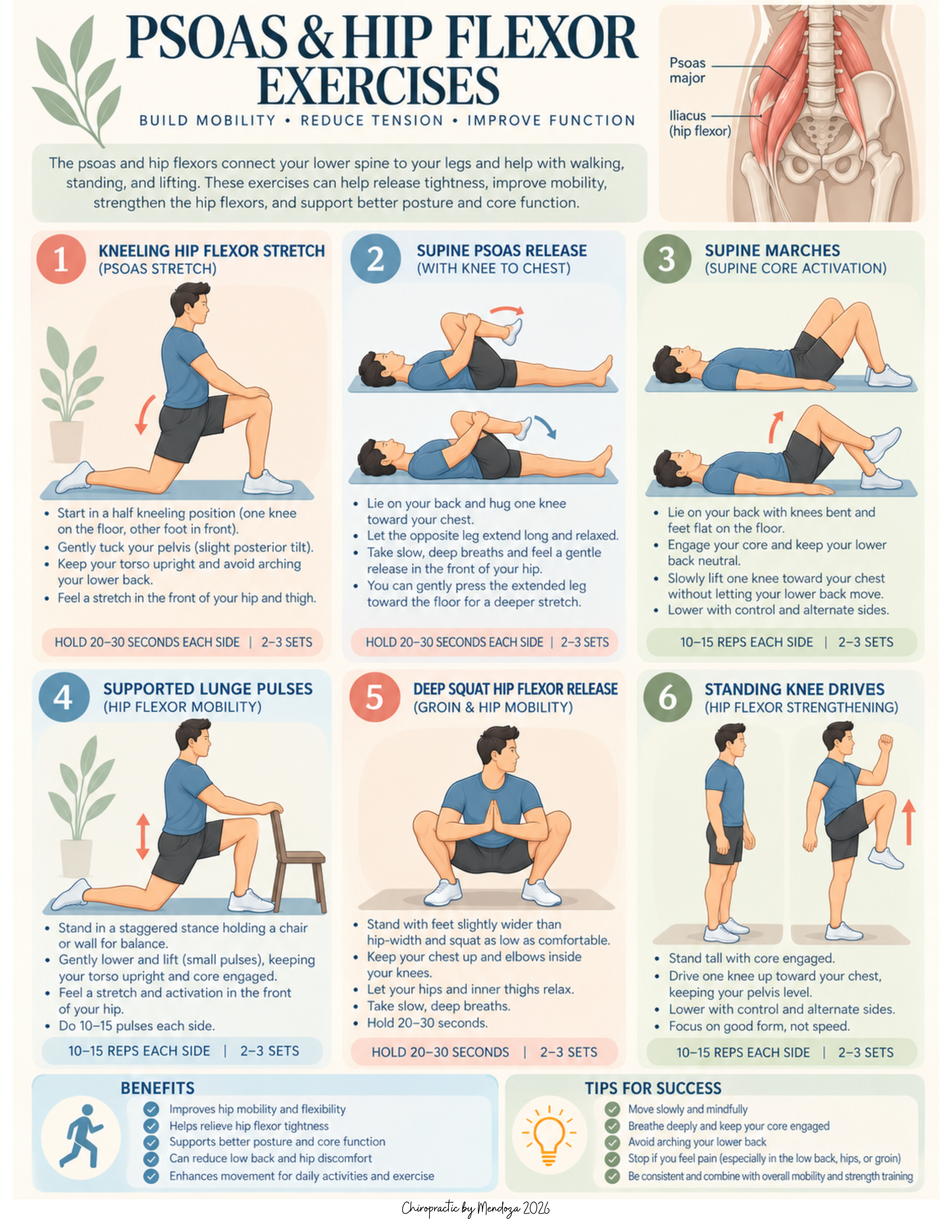
Exercises and stretches to keep your hip flexors strong and mobile!
